Principle of Instrument Thermocouples:What is the basic principle of operation for an instrument thermocouple?
Q: What is the basic principle of operation for an instrument thermocouple?
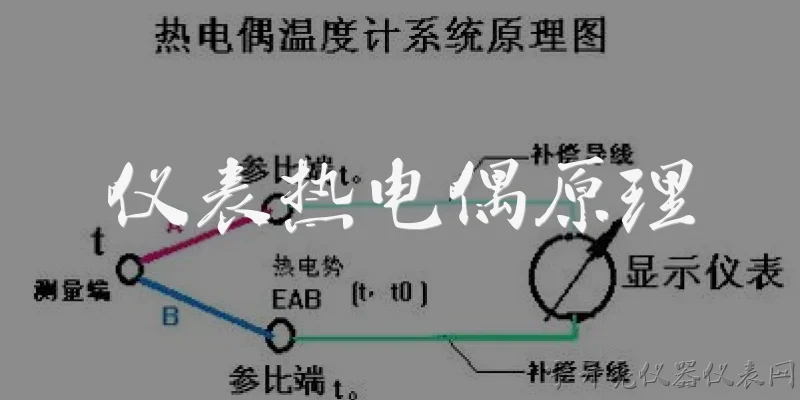
A: An instrument thermocouple operates on the Seebeck effect, which states that when two dissimilar metals are joined at two junctions and there is a temperature difference between them, an electromotive force (EMF) is generated. One junction, called the hot or measuring junction, is exposed to the process temperature. The other junction, the cold or reference junction, is held at a known reference temperature. The resulting voltage is proportional to the temperature difference. By measuring this small voltage, typically in the millivolt range, and applying known temperature-voltage relationships (reference tables), the instrument calculates the absolute temperature of the hot junction. This principle allows thermocouples to be simple, rugged, and suitable for a wide range of temperatures, from cryogenic to very high levels.
Q: Why are thermocouples preferred over other temperature sensors in industrial instrumentation?
A: Thermocouples are widely preferred in industrial instrumentation because of their unique combination of properties. They are extremely rugged, cost-effective, and can measure very high temperatures, up to about 1800°C for noble metal types, far exceeding the limits of RTDs or thermistors. Their small size and fast response time allow them to be placed in locations where other sensors cannot fit, and they respond quickly to temperature changes. Additionally, they are self-powered, requiring no external excitation, and can be used over long distances with appropriate extension wires. However, they produce relatively low output signals (millivolts), which require sensitive instrumentation and cold junction compensation. Despite these challenges, their versatility and durability make them indispensable in harsh industrial environments such as furnaces, engines, and chemical reactors.
Q: What is cold junction compensation and why is it necessary in thermocouple measurement?
A: Cold junction compensation (CJC) is a technique used in thermocouple measurement to correct for the temperature at the reference junction. The thermocouple generates a voltage proportional to the temperature difference between the hot and cold junctions. In practical instruments, the cold junction is often at the instrument terminal block, not at 0°C as assumed by standard reference tables. If the cold junction temperature varies, the measured voltage will drift, leading to inaccurate temperature readings. CJC involves measuring the actual temperature at the cold junction using a secondary sensor, such as a thermistor or RTD, and mathematically adding the corresponding voltage to the thermocouple output. This ensures that the displayed temperature reflects only the hot junction temperature. Modern thermocouple transmitters and meters incorporate automatic CJC to maintain accuracy across changing ambient conditions.
Q: How do thermocouple types differ in terms of temperature range, accuracy, and application?
A: Thermocouple types are designated by letters (e.g., K, J, T, E, N, S, R, B) and differ in their metal compositions, which determine their temperature range, accuracy, and suitability for various environments. Type K (chromel-alumel) is the most common, offering a wide range of -200°C to 1260°C and good accuracy at a low cost, but it can suffer from drift in reducing atmospheres. Type J (iron-constantan) is limited to 760°C and is prone to rusting. Type T (copper-constantan) excels at low temperatures down to -200°C and is highly accurate. Type E has the highest sensitivity among common types. Noble metal types S, R, and B (platinum-rhodium) are used for extreme temperatures up to 1800°C but are expensive and less sensitive. Choosing the right type depends on the specific temperature range, chemical compatibility, and required accuracy.
Dialogue about
Common scenarios of "Principle of Instrument Thermocouples"
【Student】 Professor, I've been reading about thermocouples and I'm a bit confused. Can you explain the basic principle behind how they work?
【Professor】 Of course! A thermocouple works based on the Seebeck effect. When two dissimilar metals are joined at two junctions, and there's a temperature difference between the junctions, a voltage is generated. This voltage is proportional to the temperature difference.
【Student】 So it's the temperature difference that matters, not the absolute temperature?
【Professor】 Exactly. The voltage is a function of the temperature difference between the measuring junction (hot junction) and the reference junction (cold junction). To get an absolute temperature, you need to know the reference junction temperature.
【Student】 How do we know the reference junction temperature? In practice, it might not be at a fixed temperature.
【Professor】 Good question. Often, we use cold junction compensation. This can be done by keeping the reference junction in an ice bath at 0°C, but more commonly, we use electronic sensors to measure the reference junction temperature and compensate accordingly.
【Student】 What are the typical metals used in thermocouples?
【Professor】 Common types include Type K (chromel and alumel), Type J (iron and constantan), Type T (copper and constantan), and Type E (chromel and constantan). Each has different temperature ranges and sensitivities.
【Student】 Why are there different types? What makes one better than another?
【Professor】 Different types are optimized for different temperature ranges, environments, and accuracy requirements. For example, Type K is popular for high temperatures up to 1260°C, while Type T is good for low temperatures down to -200°C and has high accuracy.
【Student】 Can you explain the voltage-temperature relationship more precisely? Is it linear?
【Professor】 It's not perfectly linear. The relationship is approximated by polynomial functions. For each thermocouple type, there are standard tables and equations that give the voltage for a given temperature difference. These are defined by international standards like ITS-90.
【Student】 So when we measure the voltage, we need to convert it to temperature using these polynomials?
【Professor】 Yes, typically a microcontroller or a specialized IC does that conversion. It's important to use the correct polynomial coefficients for the specific thermocouple type.
【Student】 What about the wires connecting the thermocouple to the measurement device? Do they affect the reading?
【Professor】 Yes, they can. If you connect copper wires to the thermocouple, you create additional junctions. To avoid errors, you should use extension wires made of the same materials as the thermocouple, or use a transmitter to convert the signal to a standard format.
【Student】 That makes sense. So the entire circuit must be considered, not just the thermocouple junction.
【Professor】 Exactly. The thermocouple circuit includes all junctions. The voltage you measure is the sum of voltages at each junction, but if all junctions except the measuring one are at the same temperature, their contributions cancel out.
【Student】 What are some common sources of error in thermocouple measurements?
【Professor】 Common errors include incorrect cold junction compensation, wire resistance, electrical noise, and drift due to aging or contamination. Proper shielding, twisted pair wires, and regular calibration help mitigate these.